The cross-border flow of goods is slow, but Canada’s imports of American inflation are ramping up. Government of Canada (GoC) short-term bond yields have climbed sharply since February. Gas prices were behind the initial surge, but yields are still climbing after gas stalled. A new report from BMO Capital Markets attributes the continued rise to hot U.S. inflation. The bank warns that markets are pricing in a full point of rate hikes from the Bank of Canada (BoC) by the end of 2027.
Canadian Bond Yields Pushed Higher By Hot U.S. Inflation
Higher gas prices have driven Canadian bond yields (and inflation) higher since February. BoC Governor Tiff Macklem warned yesterday that “every major central bank is worried…” because “…these costs have to go somewhere,” highlights BMO chief economist Douglas Porter.
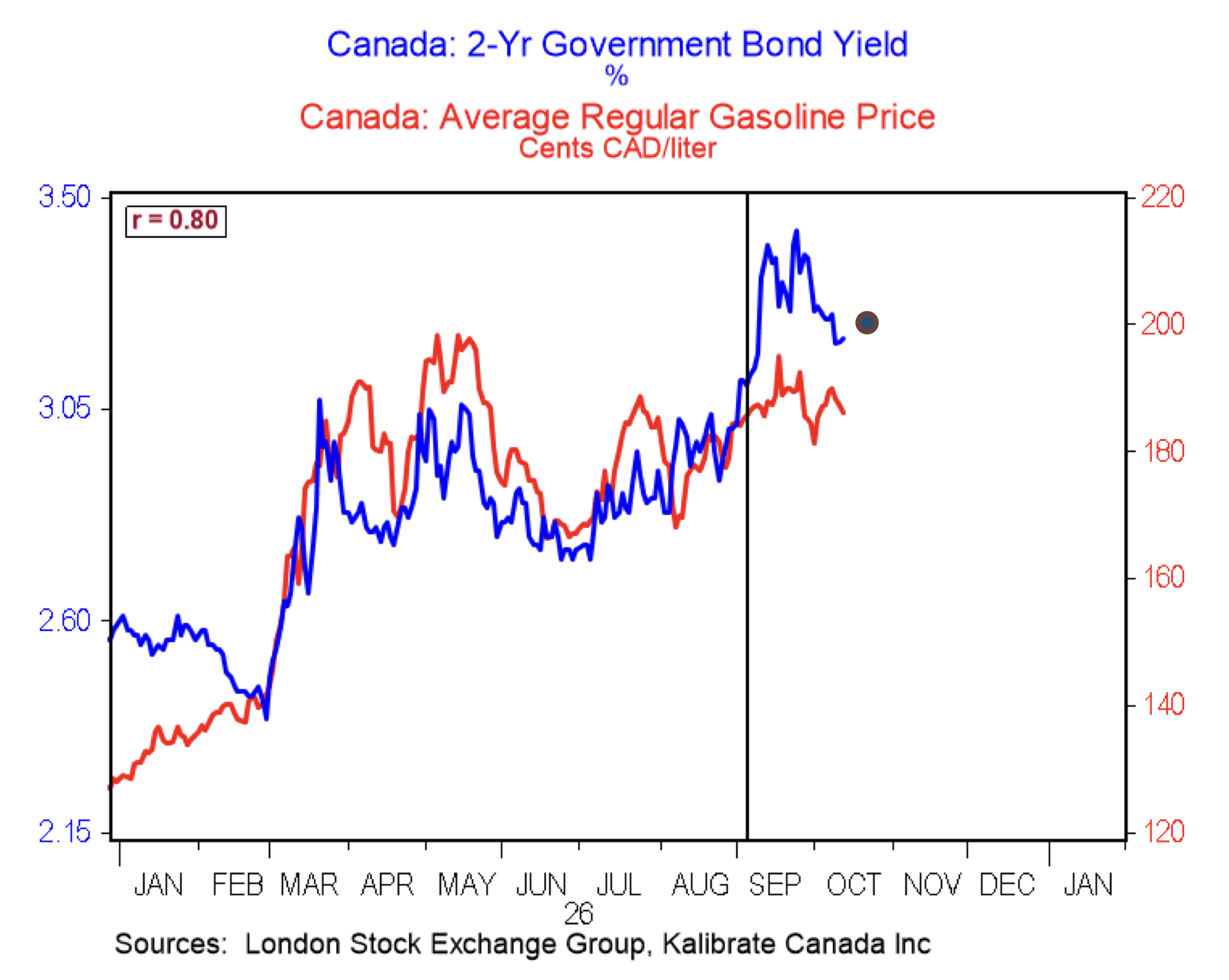
Porter’s research shows the GoC 2-year bond yield’s correlation with gas prices at r=0.8, 1.0 being a perfect correlation. Gas prices and bond yields are moving very closely together, with the divergence only starting in September. Gas prices stabilized that month, but Canadian short- and medium-term yields rose further.
Porter flags the strong US jobs report as the catalyst that month. It was followed by a US Federal Reserve speech at Jackson Hole that was hawkish, suggesting the economy is running too hot. American inflation reported yesterday reinforced those concerns, as annual growth hit 3.7% in September, well above the 2% target.
Canadian yields are responding to that pressure, in addition to the energy bump. “Accordingly, the warm U.S. CPI has bumped Canadian yields again, with 2s backing up to 3.25%,” warns Porter.
Markets Expect Canadian Rates Will Rise 1 Point
Canada’s 2-year government bond yield hit 3.25% this week, reflecting expectations of tighter monetary policy. “That’s a full 100 bps above overnight rates, and the market is indeed expecting that much tightening by end-2027,” explains Porter.
The aggressive rise means higher mortgage rates may be ahead. A full point added to the overnight rate would trickle directly into variable rates. Fixed-rate mortgages are driven by bond yields, meaning they’re likely to lead here. BMO questions whether that much tightening is warranted while tariffs and trade uncertainty weigh on Canada. “That seems like a lot,” bluntly states Porter.
BMO Questions Scale of Tightening Amid Weak Economy
The market may be pricing in higher rates, but Canada’s economy may not be able to handle them. “Now, GoC yields are being largely pulled by domestic data—the weak jobs data helped pull them lower—and U.S. yields,” explains Porter.
Porter isn’t dismissing rate hikes, but suggests that market expectations are inflated. Higher rates would throttle demand, reducing inflation further. However, there’s still the matter of currency value that Porter doesn’t address. The situation the BoC faces is a little more complicated than just a demand issue.
Global commodities such as oil, wheat, and corn are generally priced in US dollars. That’s even the case for Canadian oil, which is priced based on global demand. Weak consumption can cool domestic price pressure, but a weaker loonie can still raise import costs. If hot US inflation keeps American rates elevated while Canadian weakness calls for relief, the BoC faces a difficult trade-off. A policy miss could deepen the slowdown or prolong inflation, raising stagflation risks.